

Mission Unclear
What Trump’s war announcement reveals about a common communications mistake. Plus: Ryan Gosling gives us hope for humanity (maybe?).
A few months ago, a Wall Street Journal article got the whole comms world all breathy—“Companies Are Desperately Seeking Storytellers.” It implied that our profession is not only valued, but also that the (business) world is on fire—and we are the only ones equipped to rescue it.
The story quoted a bunch of execs who acknowledge that AI slop is creating a lot of noise that’s making it harder for them to control their brand narrative. Their response: “It sounds like I need a content strategy.”
While I don’t disagree with the AI problem (specifically AI dumbing everything down to empty filler), I do take issue with the premise. Most companies aren’t struggling with controlling a narrative. They’re struggling with clarifying what they do and putting it in context.
In other words, most organizations don’t have a storytelling problem. They have an objective problem.
I’m reminded of this as President Donald Trump launched a war over the weekend without first having a clear “what” and “why.”
You could tell because every media outlet described a different objective: deterrence, retaliation, regime pressure, regional stability.
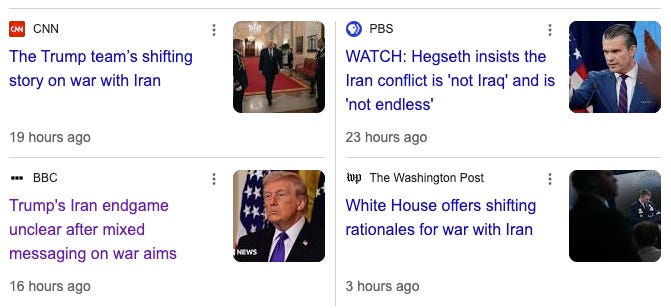
When the action starts before the objective is clear, the narrative gets written by everyone else.
The President then had to take a defensive posture yesterday because when the action started, the narrative—what was happening, why, why now, and how its good for Americans—wasn’t there. Specifically, I noticed one thing that I see a lot of my clients miss:
How will we know success when we see it? How is the world going to look different with our change in place?
AKA: The objective.
How to get your story straight
In an earlier post, I talked about this as the alignment problem in communications: before you talk about or launch anything in your personal or professional life, you need to get clear on a few things.
I like to divide this into three core areas:
What’s the change you’re making (why do we need the change? what should we expect? how will we know it’s working?)
Who are you making it for (who will be impacted? who needs to know?)
What is happening in the world all around that change that we need to understand? (why is this change relevant now? why should I pay attention to it now?)
This is a long-form way to get at getting to the objective. The most widely used formula is the SMART framework, but I like the OKR (Objective + Key Results) model because you start with that qualitative thing that feels squishy and then ground it with the measurable bits:
Objective = Qualitative Goal
Key Results = Quantified Measures
When I was at the U.S. Joint Office of Energy and Transportation, one of the hardest parts of the job was seeing headlines like “Biden’s $7.5 billion investment in EV charging has only produced 7 stations in two years.”
It wasn’t hard because we were failing, as the headline suggests. It was hard because this was not how our program should have been measured—i.e. the number of charging stations was never our total definition of success!
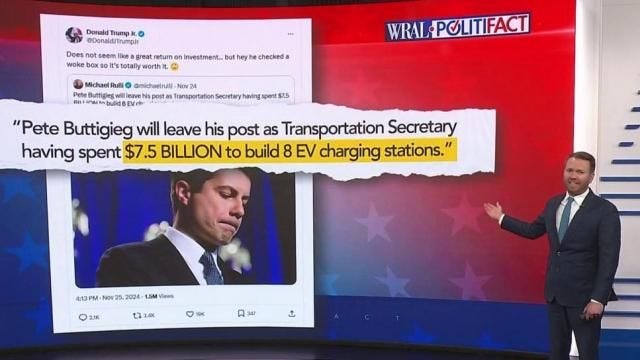
Using this example, a better way to explain one of our objectives would be (numbers are made up):
Objective: Make the EV charging network reliable and trusted.
Key results:
Reach 97% uptime across publicly-funded chargers
Reduce failed charging sessions by 50%
Increase EV driver satisfaction to 80%
But if you don’t get clear on how you want to change the world from the outset, your audience—whether it’s your board of directors, daughter’s girl scout troop, or employees—is going to be confused at best and lose a lot of trust at worst.
They see you taking action, but don’t know what it’s in service of. They show up to events and meetings, but don’t know how to participate. They question your tactics, because there’s no common vision for the future.
Ideas + narrative = vision
I recently worked with a transportation government body. It was founded in the 1970s. The EPA had just been created. Uber and Lyft certainly hadn’t.
Put simply: today, the agency is solving a completely different set of transportation problems than the ones it was created to govern. And yet until recently, it’s been acting as though its original vision for the future is what it’s working toward.
Recent leaders of this agency have put forth solid policy ideas, and even some have made meaningful impacts. But ideas without narrative are just tactics. Its effectiveness is limited. You need to wrap the ideas in the context and urgency of the moment, and in whom it’s for and how it helps them. That’s how you get to a durable vision.
They’ve been tackling this with me as a sequential three-step process:
They’ve started to reset the narrative—“We set out in 1970s to accomplish this goal, and we did it. Now things have changed, and we have to change, too.” That reset makes the ideas—the stuff they want to do—make sense to their audience. It gives the agency permission.
The next step is defining exactly what they mean by “change.” We decided that the their change can be best explained in three buckets: who it serves, what it does, and how it works. All three of these areas need to change, and all three are backed with proof points to demonstrate why and why now.
Finally, and most importantly, how will the world look different with these changes in place, and how will the key audiences benefit from it? This helps to make clear how we will know the change is here, or at least directionally in-progress. And it will keep stakeholders aligned and engaged, because they will see that it’s working.
Find clarity, then story
The WSJ piece got one thing right: communications is hard. But it’s not a storytelling shortage. It’s a clarity shortage. And you can’t hire your way out of a clarity problem.
Whether you’re the President explaining a war, a federal office defending a $7.5 billion investment, or a 50-year-old agency redefining its purpose—the question is the same: What are we actually trying to change, for whom, and how will we know when it’s working?
Get that wrong and you’re just making noise.
Get it right and you’re not just telling a story. You’re giving people a reason to believe in the future you’re trying to build.
Have a thing you’re working on and not feeling confident on how to communicate it? I made a handy guide for that. It’s free. Get the whole thing here.
Worth your attention
Three things that taught me something this week:
Media used to see customers as a “citizenry to engage'“—then in the 30s its business model shifted to a consumer base to sell. This is the history lesson we need at this Paramount moment of “media capture.” Listen to professor of media policy and political economy at the University of Pennsylvania Victor Pickard on On the Media
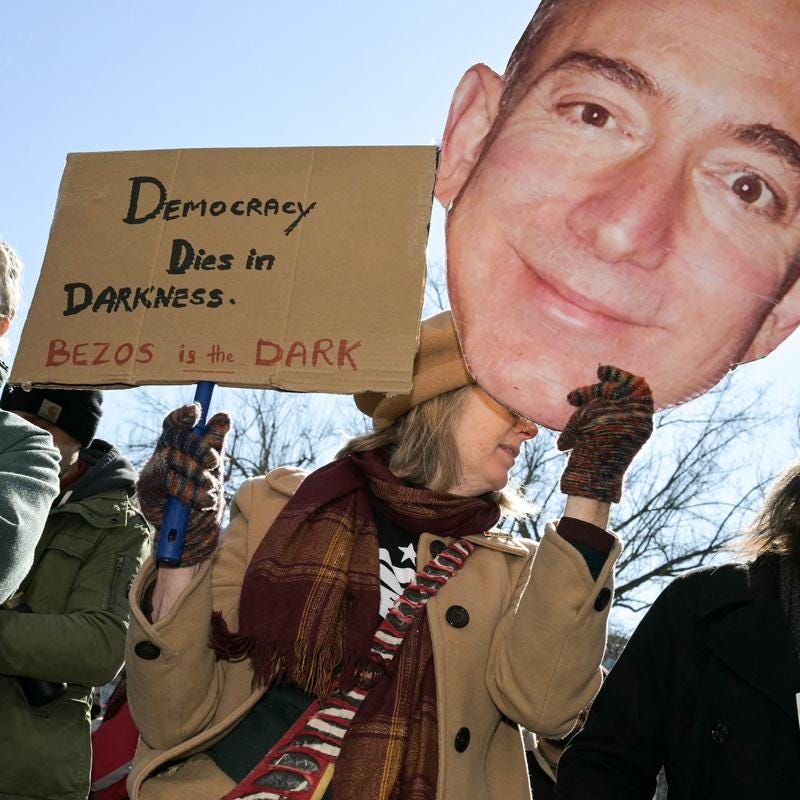
The face of “media capture.” Source: WNYC Hope for humanity: It sure looks like we’re trying to burn each other down in the name of peace. But reading Project Hail Mary gave me hope that if things get really really bad, we’ll pull together (not a spoiler!). I left feeling hopeful for our future and excited to see how Ryan Gosling brings it to the big screen. (I read the hardback, but have had multiple people in my life vouch for the audio version.) Get it at your local library or on Bookshop

Notice differently, feel more alive. I don’t even remember when I learned about Rob Walker, but I know it was when his brilliance was still on a blog! Rob’s book The Art of Noticing is a practical jolt of humanity, and thank goodness he has kept the observant party going on The Art of Noticing Substack. HIGHLY recommend subscribing.
Thanks for reading Trust Issues, the Tuesday newsletter bringing you ideas on how and why people and ideas change, and the role of trust.
Liked what you read? Share with a friend or just give it a heart. <3
“When the action starts before the object is clear, the narrative is written by everyone else.” I love this sentence, it says so much.
It reminds me of an old saying: “Be sure you’re right-then go ahead.”
You can’t be right without an objective.